
Authorship
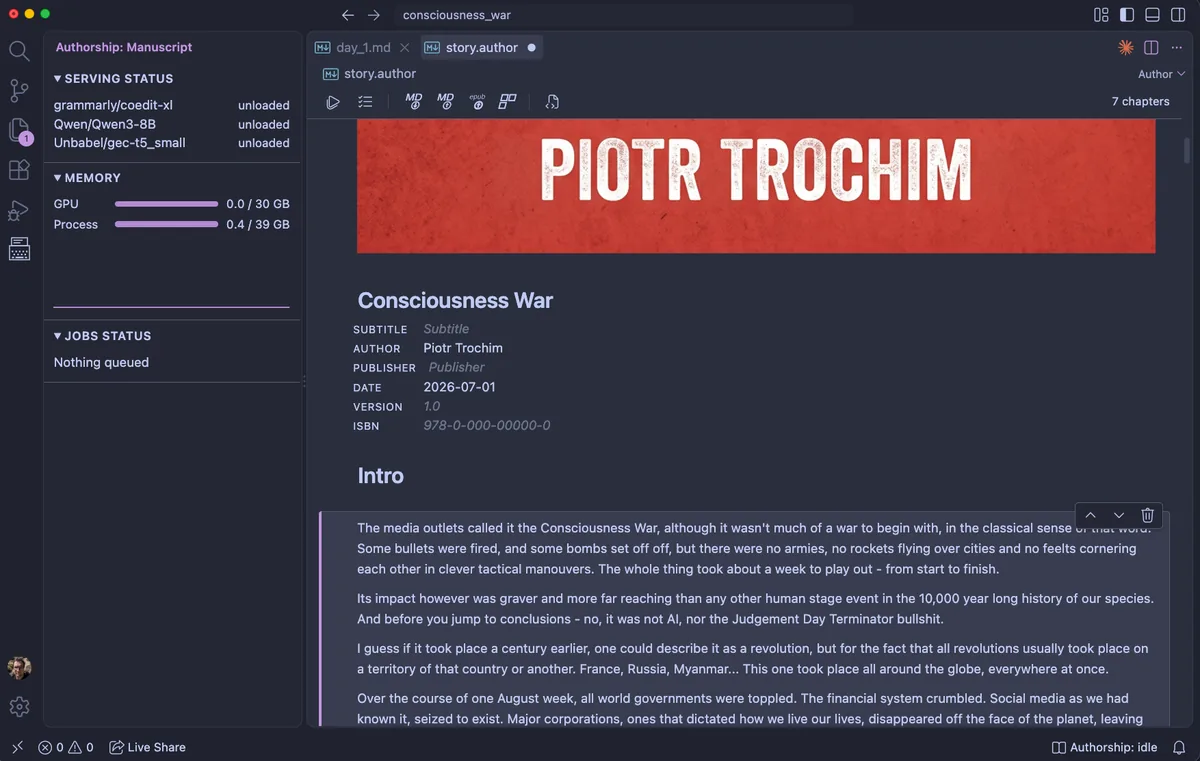
Creative writing is fundamentally an information architecture problem. Authorship applies Robo Data Lab's core research in trajectory retrieval, causal world modeling, and local inference to manage narrative complexity, analyze craft, and automate the manuscript lifecycle.
Core Research
kind: VS Code extension status: In development
links:
- { label: GitHub, href: “https://github.com/robodatalab/writer” }
- { label: Install on VS Code Marketplace, href: “https://marketplace.visualstudio.com/items?itemName=RoboDataLab.authorship” }
- { label: Read the Documentation, href: “https://github.com/robodatalab/writer#readme” }
Beyond Static Search: Causal State Trajectories
Traditional retrieval systems treat documents as static spatial clusters, calculating naive vector similarity over isolated chunks of text. In long-form narrative, this architecture completely collapses: standard embeddings cannot encode temporal sequence, are blind to cause-and-effect, and fail to track evolving entity states across 80,000 words.
Authorship is the production proving ground for Robo Data Lab’s foundational research into State-Aware Trajectory Retrieval. Instead of static keyword matching or point-wise similarity, we formulate narrative comprehension as policy-driven state space unrolling—compiling text into a continuous world model that tracks how character states, knowledge, and thematic constraints evolve over time.
This research directly powers our upcoming analytical engine:
- Causal State Search: Retrieving information conditioned on narrative events (e.g., “what did the protagonist know after the trial in Chapter 6?”) while suppressing contradictory pre-event states.
- Character Arc & Entity Tracking: Tracing entity consistency, voice integrity, and presence across the whole manuscript to catch when a character vanishes or acts on unearned information.
- Plot Flow & Narrative Invariants: Evaluating plot trajectory coherence to flag broken causal chains, unseeded events, and pacing drops across complex multi-POV structures.
Complexity Management & The Abstraction Layer
In Authorship, a Section represents an instance of an abstraction—identical to a function or module in software architecture. When prose is muddy, it is usually because a single section has mixed multiple conflicting abstractions at once: interleaving immediate action with backstory exposition, thematic commentary, and unrelated character beats. Our refactoring tools analyze this semantic boundary leakage, giving authors the ability to isolate and refactor passages into clearly separated, clean abstractions.
Once sections carry clean abstractions, the problem becomes Story Flow and Cognitive Pacing. A novel cannot sustain reader immersion if it lingers monomaniacally on a single subplot or jumps erratically between characters. Our narrative pacing engine builds directly on top of our State-Aware Trajectory Retrieval Research:
- Semantic Understanding as Search Foundation: Traditional search looks for keywords; Authorship’s document analysis understands what each section is really about—its core themes, active character agents, and informational delta, utilizing the same state-unrolling principles detailed in our Semantic Search paper.
- Cognitive Load & Reader State: By understanding the semantic payload of each section, the pacing engine tracks what the reader knows at any point in the text, their attention span, and how quickly new information is committed to memory before coming plot points demand that context. It flags when narrative transitions are too chaotic or when a subplot has starved too long.
- Macro-Level Chapter Synthesis: At higher levels of abstraction, this same semantic foundation maps chapters and parts into structured summaries. Authors can instantly see which chapters contain which subplots, verify where plot threads cross, and understand the thematic footprint of the whole manuscript at a glance.
The Creative Lifecycle & Abstraction Layers
The creative writing lifecycle is fundamentally a continuous journey across four distinct abstraction layers. The act of authoring is defined by how the writer moves between the Micro Loop (immediate drafting and scene pacing) and the Macro Loop (global coherence and plot architecture):
- The Manuscript (L1, Macro Loop): The overarching whole. Authors work at this level to manage global architecture, overall narrative momentum, and the balance of key story milestones across the entire book.
- The Chapter and Part (L2, Micro Loop): The structural reading container. Authors organize the sequence of scenes here, ensuring that new information is introduced at a digestible pace without overloading the reader’s attention span.
- The Plot Thread (L3, Macro Loop): The causal trajectory of a storyline (such as a romance, a mystery, or a political shift) as it develops across multiple chapters from setup to resolution.
- The Character and Scene Beat (L4, Micro Loop): The atomic drafting level. Authors draft raw dialogue, capture intent in private margin notes, explore voice, and refine prose rhythm sentence by sentence.
During drafting, the lifecycle demands constant jumping between these layers: you spark an immediate scene beat (L4), zoom out to the manuscript view (L1) to see how it reshapes the global outline, dive into a specific chapter (L2) to place it in context, and then evaluate the broader plot thread (L3) to ensure causal continuity still holds.
Connecting Lifecycle Loops via Trajectory Search: In traditional flat text editors, this multi-layer dance causes severe disorientation. Authorship’s search engine bridges the Micro and Macro loops using the principles of our State-Aware Trajectory Retrieval Research. By querying a concept (such as “Alice’s character arc”), the engine cuts vertically through all structural layers simultaneously. It isolates the relevant character beats (L4), places them within their immediate chapter context (L2), and connects them along their overarching plot trajectory (L3)—letting the author refactor that specific concept in isolation while maintaining complete command of the full manuscript architecture (L1).
In-Line Editorial Reviews & Continuous Feedback
Standard word processors treat editorial feedback as mechanical spell-checking and basic grammar linting. Tools like Word or Google Docs evaluate sentences in complete isolation, oblivious to whether a line advances a character arc or completely breaks narrative causality established three chapters earlier.
Authorship includes fast, native spell and style checking—strictly tuned for the nuances of literary English. But its real intelligence builds directly on top of our document understanding engine from our Trajectory Search Research, transforming passive spell-check into continuous, story-level editorial feedback while you write:
- Story Pacing: Detecting cognitive bottlenecks where information density spikes too quickly, or flagging subplots that have been starved for narrative attention across long chapter gaps.
- Plot & Story Consistency: Tracing causal dependencies across the book to catch timeline contradictions, broken narrative promises, and logical leaks between separate POV tracks.
- Fact Grounding (No Magic Out of a Hat): Ensuring that key objects, skills, or critical plot revelations were organically seeded earlier in the story rather than abruptly invented to resolve a scene.
- Character Development Trajectories: Tracking character depth, active agency, and voice consistency across every chapter to ensure relationships and emotional stakes evolve rather than drift.
Actionable Feedback in Action: A Refactoring Scenario
Because this analysis runs in real time directly alongside your draft, feedback guides your structural decisions as your ideas evolve:
- Discovering the Void: You have drafted ten chapters, but the middle act feels weak. The analysis alerts you that Julian—initially introduced as a tangential background figure—has grown central to the climax, yet lacks foundational backstory and feels shallow.
- Drafting Anywhere: You immediately write two new sections defining Julian’s motivations and origins. You draft them at the very bottom of the document—simply because that is where your cursor was.
- Placement Analysis: The engine evaluates the newly introduced character state against the timeline, flagging that this backstory needs to land before Julian’s key decision in Chapter 2. It recommends moving the sections directly after Chapter 1. You drag them into place and open a new chapter.
- Causal Grounding Check: The moment the sections are moved, the engine evaluates downstream consistency and flags an immediate contradiction: the military background you just gave Julian in Chapter 2 contradicts his alibi in Section 3 of Chapter 5.
Instead of discovering structural flaws months later during an agonizing 80,000-word reread, Authorship surfaces the exact causal ripples of every change the moment you make it.
Empowering the Creator: Analysis, Not Generation
The rise of generative AI in creative writing has sparked justifiable concern among authors and artists. When automated tools attempt to ghostwrite prose, they strip away the author’s voice, flatten narrative texture, and disconnect the writer from their own creative vision.
Authorship takes an uncompromising stance: the author is the sole creator.
Our models do not write your novel, generate plot twists out of thin air, or autocomplete your sentences. Instead, Authorship is built exclusively for structural intelligence, diagnostics, and narrative analysis—giving human authors the cognitive tooling needed to command complex manuscripts without losing control of their craft.
We restrict generative AI to exactly one specific, explicitly labeled use case:
- Drafting Storefront Blurbs: During the publishing workflow, Authorship can read across your finalized chapter trajectory to produce an initial draft of marketing copy and back-cover blurbs. It acts purely as a publishing assistant, never touching the body of your prose.
Every word, character arc, and thematic beat remains 100% yours. Authorship exists to empower the writer, not replace them.
100% Local Inference & Free Tooling
Completely Free, Zero Subscriptions: Authorship is free of charge and free to use. There are no paywalls, recurring monthly fees, or metered token costs.
100% Local & Private: Writing is intensely personal. Our background analysis and trajectory evaluators execute entirely on your own machine via a local loopback server (127.0.0.1:8765). Your manuscript is never sent to the cloud, never uploaded to third-party APIs, and never used to train external models.
- Current Availability: Authorship is currently built as an extension for Visual Studio Code. If writer demand dictates, we plan to port the toolchain to support other major editors or package it as a dedicated, standalone writing desktop application.
- Hardware Requirements: Because all deep semantic understanding and trajectory models run entirely on-device without cloud compute, running the local analytical engine requires a laptop or workstation with at least 24 GB of unified RAM.